

Biomechanical Optimization
of Daily life, Exercise, & Sports
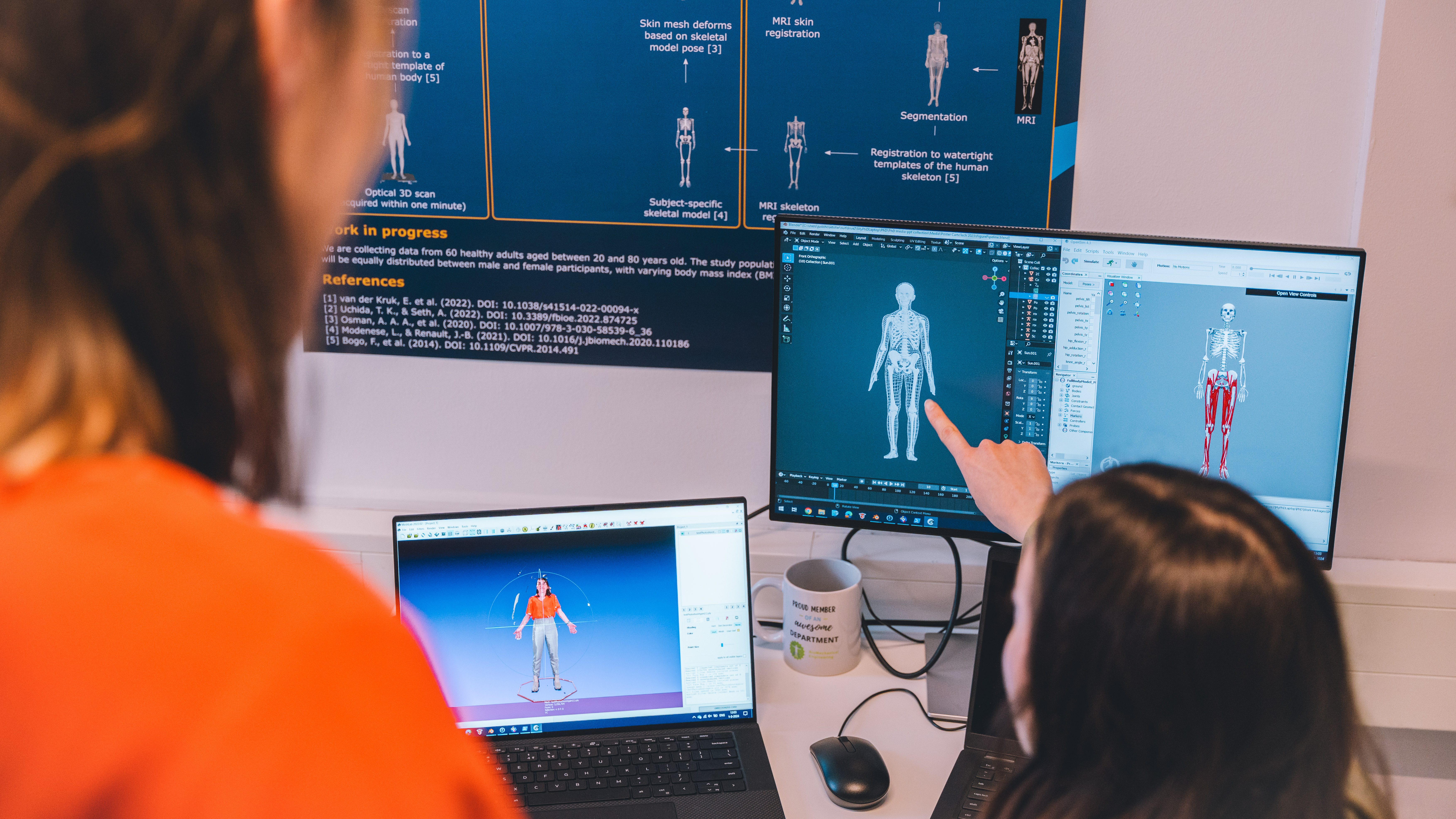
BODIES lab is a scientific research group at the department of Biomechanical Engineering, faculty Mechanical Engineering, located at Delft University of Technology, the Netherlands.

Our Vision
We develop computer simulations of the human musculoskeletal system to analyze and optimize human movement.
At BODIES lab, we envision a future where mechanically accurate digital models of the human body guide personalized healthcare and enhance performance. We strive for models that reflect the full diversity of bodies, and where personalized technologies empower everyone to reach their movement potential.
Participate
If you are interested in visiting the BODIES lab and taking part in our research, click below learn more about current studies and what taking part involves.

Our research
We use a multi-modal approach to understand how the human body moves. By combining advanced measurement techniques with computational modelling and simulation, we study how muscles, bones, and tendons work together to produce movement. We integrate data from imaging, motion analysis, and anatomical studies into detailed musculoskeletal models that allow us to explore key questions such as: How can rehabilitation be tailored to a specific patient? What is the most efficient technique for a specific athlete? How can medical interventions such as implants be optimized for better outcomes?
Our goal is to improve healthcare and sports performance by making training, rehabilitation, injury prevention, and medical interventions more precise and individually tailored.
We recognize that biomechanics has long been shaped by gender bias, influencing research priorities, experimental design, and data interpretation. We call this challenge BIASMECHANICS to actively promote awareness and change within the field. Our work centers on the diversity of bodies, striving to build models, technologies, and knowledge that are inclusive, representative, and equitable.